Working on an offshore wind turbine involves operating in a demanding environment where risks associated with the sea are ever-present. That is why the GWO Survival at Sea training course is an essential step for all technicians who will be working on offshore wind farms.
At our training facility in Marseille (FRANCE), this module provides participants with the essential knowledge and skills needed to prevent risks, respond effectively in an emergency, and increase their chances of survival while waiting for help to arrive.
Why take the GWO Survival at Sea training course?
The Survival at Sea module, which complies with the requirements of the Global Wind Organisation (GWO), prepares professionals to handle emergency situations that may arise during offshore operations.
This training program combines theoretical instruction with practical exercises so that each trainee will be able to act quickly and safely in a real-world situation.
A morning dedicated to understanding risks at sea
Understanding the Offshore Wind Energy Environment
The training begins with an overview of the wind energy sector in France. Participants will learn, in particular:
- The development of offshore wind farms;
- How an offshore wind turbine works;
- The evolution of technology over the years;
- The different types of foundations and floats used.
This introduction provides a better understanding of the specific challenges of working at sea.
Identify the risks associated with offshore operations
Trainees are then made aware of the main risks encountered on an offshore wind turbine:
- The risk of falling;
- Boat landing operations, that is, the transfer between a boat and a wind turbine;
- The various ways to access offshore facilities, by boat or by helicopter.
The process of removing a part by boat is explained to prepare future technicians for this delicate operation.
Preventing Drowning Hazards
A significant portion of the module is devoted to the consequences of falling overboard.
Trainees study:
- The mechanisms of hypothermia;
- The different stages of immersion;
- Life expectancy in water, depending on conditions;
- Ways to limit heat loss;
- Caring for a Victim of Hypothermia.
The training also covers drowning, its causes, its consequences, and the steps to take.
Finally, the trainees learn about the symptoms of seasickness and ways to minimize its effects.
First Scenario: The Boat Landing
The morning ends with a practical exercise involving a simulated boat landing.
Interns are responsible for, among other things:
- Climbing up and down a ladder;
- A safe transfer from the dock to the boat.
This exercise allows you to practice the movements performed during an actual emergency response.

Afternoon: Learning how to survive and organize rescue efforts
Warning and Signaling Systems
The afternoon begins with a presentation on the various types of emergency equipment used at sea.
Participants will learn:
- Radio and telephone communication systems;
- VHF and VHF ASN;
- EPIRB (RLS) beacons;
- Equipment that complies with SOLAS regulations;
- Smoke bombs;
- Parachute rockets;
- Hand-held flares.
The various visual and audible signals used to guide emergency responders are also being studied.
Handling Safety Equipment
The theory is then followed by several hands-on workshops.
Participants learn how to use:
- A smoke bomb;
- A parachute rocket;
- A handheld torch.
These exercises help participants become familiar with equipment that can save lives in an emergency.

Survival Techniques at Sea
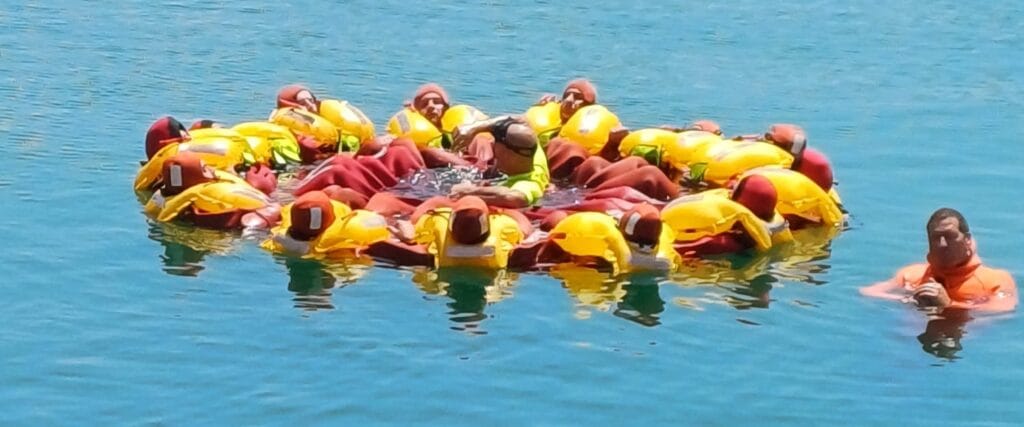
The second half of the afternoon is devoted to exercises in the water.
In particular, participants will:
- Group movements in the water;
- How to deploy a life raft;
- Righting an overturned raft;
- Individual and Group Survival Positions in Water
These exercises simulate situations that technicians may encounter following an evacuation at sea.
The Helicopter Rescue Exercise
The training concludes with a helicopter winch exercise.
This simulation helps trainees understand the procedures to follow during a helicopter evacuation and adopt the proper behaviors to facilitate the rescue teams’ response.
Essential training for working in the offshore wind industry
The GWO Survival at Sea module goes beyond teaching technical skills. It prepares professionals to anticipate risks, keep their composure, and respond appropriately in the event of an accident at sea.
Through a balance of theory and practice, trainees develop the essential skills needed to work safely at offshore wind farms.
This training program is delivered and supervised by professional instructors and divers under conditions that closely resemble real-world scenarios, in order to ensure that participants develop skills that meet the requirements of the wind energy industry and the Global Wind Organization (GWO) standard.